.svg&w=384&q=75 "Pitchgist logo")
Canada's Historic World Cup Win Overshadowed by Ismaël Koné's Injury
Canada’s night of history ended in silence.
What should have been a pure celebration of a first-ever World Cup victory turned into something far more sobering in Vancouver on June 18, 2026, as Ismaël Koné left the field with a gruesome leg injury that stunned teammates, opponents and fans alike.
Canada thrashed Qatar 6-0 in Group B. Jonathan David hit a hat trick. Nathan Saliba came off the bench and scored. Qatar finished with nine men. On any other night, that would dominate the story.
Not this one.
A tackle that changed everything
Midway through the second half, with Canada already cruising, Qatar midfielder Assim Madibo lunged in from behind on Koné. The 24-year-old went down instantly, his left leg trapped under the weight of the challenge.
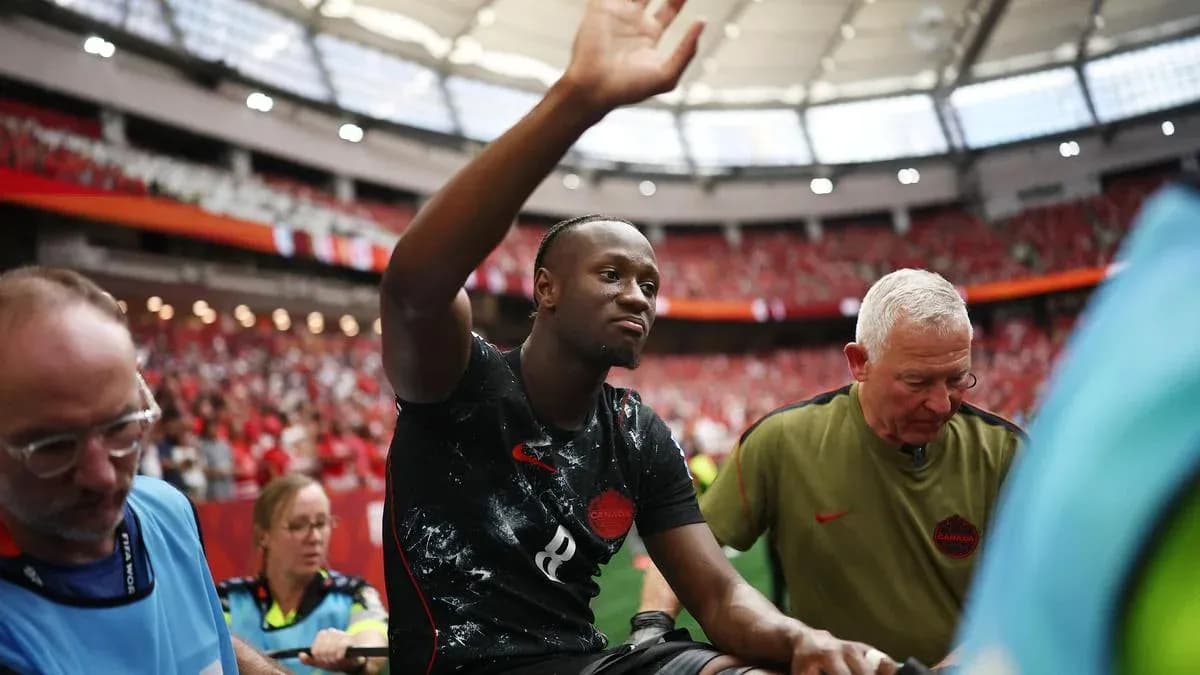
The reaction told its own story. Koné grimaced, then barely moved. Canadian players sprinted toward him, waving frantically to the bench. Medical staff rushed on as his teammates formed a protective ring, shielding him — and the severity of the injury — from the crowd and cameras.
Madibo saw red for the tackle, leaving Qatar down to nine men after Homam Ahmed’s first-half dismissal. The decision felt inevitable. The damage was already done.
“I saw his leg. I saw that something wasn't right,” captain Stephen Eustáquio said, one of the first to reach Koné. Those few seconds turned a joyous occasion into a scene of shock.
On the touchline, Canada coach Jesse Marsch had an uncomfortably clear view.
He said the challenge happened right in front of the bench and you could hear the “bones snap.” Koné was quickly stretchered off and taken straight to a local hospital, where, according to Marsch, he was preparing for surgery surrounded by family.
“Everybody was crushed when it happened, but we had to find a way to stay focused, we knew that Ismaël wanted us to finish the job,” Marsch said. “There's a lot of thoughts that go through our heads right now, we're all thinking about him, but we're all very proud of what we are.”
The exact details of the injury have not yet been disclosed, but images from the field showed his lower left leg visibly out of place. Nobody needed a medical report to understand the gravity.
Marsch added that Madibo later offered a personal apology to Koné, a small gesture on a night that will haunt the Qatar midfielder.
Playing for Koné
The match resumed, but the mood had changed. The roar inside the stadium dropped to a murmur. Every Canadian touch seemed to carry an extra weight.
Then the game delivered its cruel, poetic twist.
Less than 10 minutes after Koné left the field, his replacement, Nathan Saliba, stepped into the spotlight. Arriving late in the box, he swept home Canada’s fourth goal of the night. There was no wild celebration, no choreographed routine. Saliba grabbed Koné’s jersey, lifted it high, and held it there.
An emphatic scoreline suddenly felt like a tribute.
Canada kept going. David completed his hat trick, the finishing touch on a ruthless attacking performance. Yet even he questioned how the injury had come about.
“If there's a play where you cannot win the ball, there's no point,” David said. “It's just to hurt people.”
His words cut through the usual post-match clichés. This wasn’t about a marginal call or a 50-50 challenge. In the eyes of Canada’s players, the tackle crossed a line.
History with a heavy cost
Strip away the emotion and the numbers are impressive. A 6-0 win. A hat trick for David. A first World Cup victory in the country’s history. A team that looked sharp, confident, and ruthless in front of goal.
But the defining image of the night is not a goal. It is Koné, surrounded by teammates, leaving the field on a stretcher while thousands watched in stunned quiet.
“We're going to miss (Koné),” Eustáquio said. “He has that X factor that our team really needs.”
Canada will move on in this World Cup, buoyed by three points and a statement performance. The squad has shown it can score, dominate, and punish an opponent reduced to nine men. The belief in what this group can achieve will only grow.
Yet from here on, every Canadian team sheet will carry the same unspoken question: how far can they go without the player who was supposed to give them that extra spark?