.svg&w=384&q=75 "Pitchgist logo")
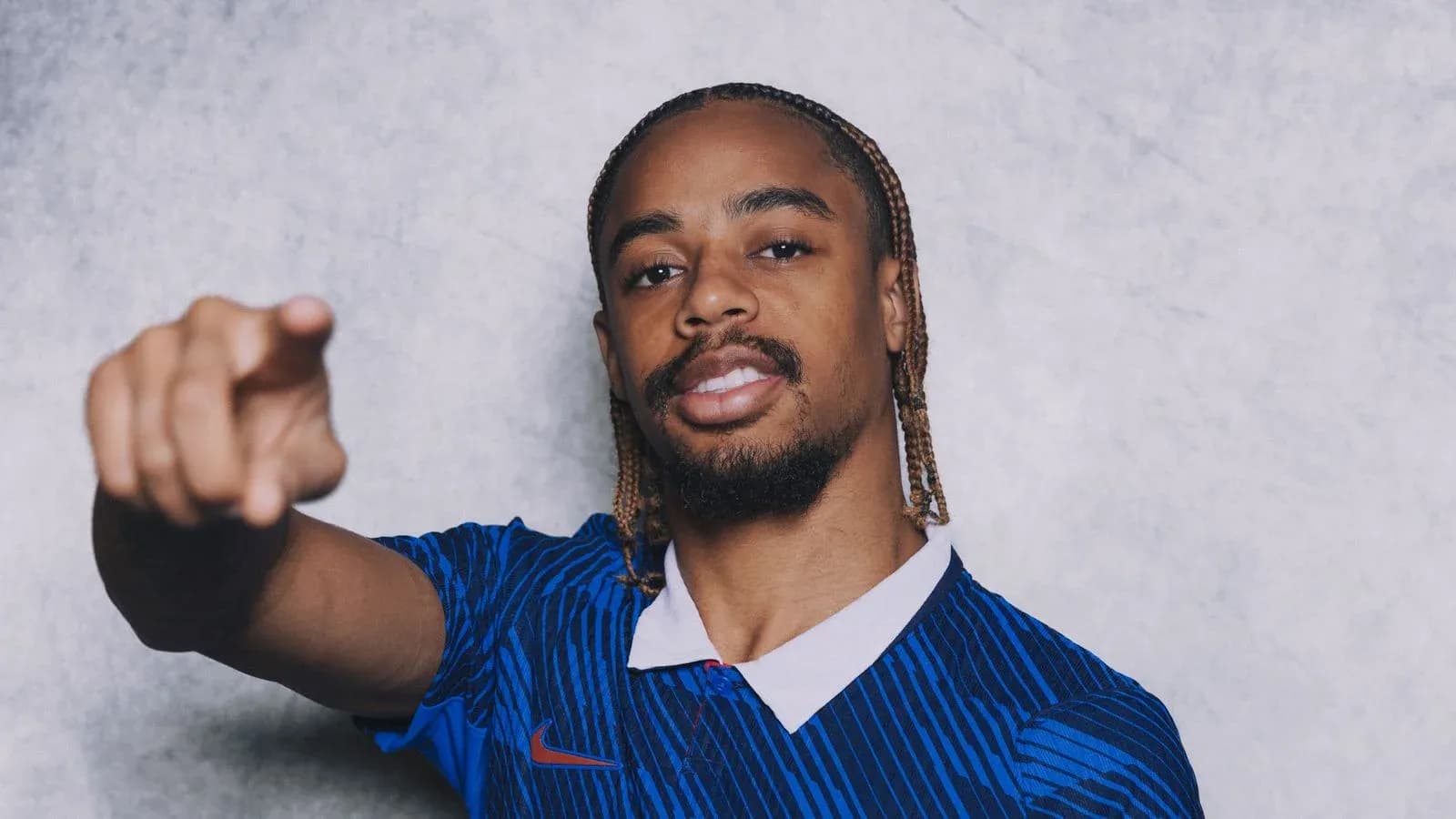
Bradley Barcola: The Rising Star of European Football
Bradley Barcola is about to find out what a price tag really feels like.
Liverpool want him. Arsenal want him. Paris Saint-Germain may be about to cash in on him. By the end of this window, the 23-year-old could be the most expensive transfer of the summer, a Champions League winner changing clubs at the peak of his momentum.
All that, and he is not even a guaranteed starter at PSG.
A Champions League winner off the bench
Two seasons, two Champions League titles. Barcola has both medals in his pocket, but not yet the status that usually comes with them. In each final he came on from the bench, the impact option rather than the undisputed star.
His problem is a luxury one. Khvicha Kvaratskhelia’s arrival from Napoli in January 2025 turned the left flank into one of the most hotly contested positions in Europe. The Georgian took the starting role. Barcola became the weapon waiting in reserve.
Yet the clubs circling him are not looking at minutes played. They are looking at what happens when he is on the pitch: pace that rips open defensive lines, a frame that can ride contact, and a sharp, developing football brain shaped under Luis Enrique. The fee being discussed speaks to potential as much as production.
With Barcola, both are huge.
The sliding-doors moment at Lyon
His rise has not followed the usual script for a €100m footballer-in-waiting. No age-group stardom. No early promotion through the ranks. No teenage headlines.
At Lyon, he hovered on the fringes of the first team under Laurent Blanc. Another promising youngster who might, or might not, get there. Then one decision changed everything.
Karl Toko Ekambi wanted out.
“A club in Switzerland was interested because he was not playing for the first team,” recalled Jean-Francois Vulliez, who worked with Barcola in Lyon’s academy and later followed him to PSG as a development coach. Toko Ekambi’s desire to leave forced Blanc to reconsider his options. The loan was stopped. Bradley stayed.
One game later, an injury. Suddenly, Blanc needed him.
That was the opening. Barcola stepped through it. Five goals in nine games in early 2023 turned a squad player into a serious prospect. Performances at that summer’s European Under-21 Championship confirmed it. His body remained in Lyon, but, as Vulliez put it, “his head was in Paris.” The move to PSG dragged on, then finally happened.
From that point, everything accelerated.
The late bloomer who learned to think
What makes his story intriguing is how ordinary his youth career looked. No skipping age groups. No fast-tracking. No France youth caps. Vulliez describes him as “a normal kid” whose development followed a “normal process.”
He was not physically ready early on. That mattered. He could not dominate defenders with strength, so he had to find another way.
“He developed his intelligence,” Vulliez explained. Barcola learned to scan the pitch, to read space, to use his speed with purpose rather than just running. Only later did the muscles arrive to match the mind.
That balance now defines him: tactical awareness, technical ability, and physical power, all layered on top of each other rather than arriving at once. It is why coaches trust him. It is why he can adapt.
“We never had a problem with him at the academy because he is intelligent and listens,” said Vulliez. Give Barcola a plan, and he understands it. Change the plan, and he adjusts. That is gold dust at the top level.
Vulliez is blunt about one thing: “I do not think you can transform a player after the age of 17 because if the player does not have the intelligence at that age then they will never have it.” Barcola had it. That is why his position can still evolve.
A winger who thinks like a striker
On paper, he is a left-sided wide forward. In reality, he moves like a No 9 who has been pushed out to the flank and told to improvise.
At Lyon, he played through the middle until he was 17. The habits never left. From the left, he cuts inside onto his stronger foot, shapes to the far corner, and attacks the box as if he belongs there. Those instincts are not easily taught, which is exactly why elite clubs pay a premium for wide players who possess them.
He brings numbers. Goals and chances. The data backs it up: his shot volume for PSG last season placed him among the top 10 players in Ligue 1 per 90 minutes. Playing wide does not blunt his threat.
“He is very clever with his runs inside,” Vulliez said. Timing is the key. When to drop between the lines. When to dart beyond the last defender. When to appear in the blind spot of a centre-back and explode.
“Because he played as a striker, he retains that ability to know when he needs to come inside and when he needs to run beyond,” Vulliez added. Put him in a team that wants runners from deep and he becomes a constant problem.
Luis Enrique’s refinement
The raw attributes were obvious. Luis Enrique has worked on the rest.
Across more than 150 appearances for PSG, Barcola has collected 39 goals and an astonishing 13 trophies in three seasons. But the transformation goes beyond medals and numbers. His game with the ball has matured.
Under Enrique, he has learned when to drive at defenders and when to keep it simple. When to take a risk and when to recycle. The reckless dribbler of his early days has been replaced by a forward who values possession and picks his moments.
He is a better player than the one who arrived in Paris. Better than the teenager in Lyon’s academy who never stood out as a future superstar. “Nobody could have imagined this,” Vulliez admitted.
And yet, there is still a glaring area to improve.
The finishing question
For all his goals, Barcola’s finishing can still look loose. Chances go begging. Composure deserts him at times. Luis Enrique has not ignored it. He has pushed the player hard to become more clinical in front of goal.
“There are many very good players who improved their finishing when they became more mature,” Vulliez pointed out. Barcola has time. He has the mindset to respond to that push. The expectation is that the end product will catch up with the rest of his game.
That is where the real ceiling lies. If he sharpens that final touch, the conversation around him changes again.
Versatility and raw speed
The attraction for Liverpool, Arsenal and others is not just about what he is now, but what he might become.
He can play on the left, where he currently looks most dangerous. He can flip to the right, stretch the pitch, and hit the byline with his pace if a coach wants width and crosses. He ranked among the top 10 fastest players in the Champions League last season. Give him grass to attack and he will simply knock it past you and run.
Vulliez is already thinking beyond the wings. “Maybe the left wing is the better position for him right now but I am curious to see how he develops because I believe he is able to become a No 9.” That is not a throwaway line. It is a projection based on his instincts, his movement, and his intelligence.
The flexibility makes him even more valuable in an era when top clubs crave forwards who can interchange, press, and threaten from multiple zones.
How much better can he get?
Strip it back and the picture is clear. A late developer who had to think his way through games before his body caught up. A wide forward who moves like a striker. A Champions League winner who still comes off the bench. A player trusted by elite coaches because he listens, learns, and adapts.
He has already won more than most players manage in a career. He has already shown enough to draw heavyweight Premier League interest and a potentially record-breaking fee.
The real question, the one Liverpool, Arsenal and PSG are wrestling with now, is simple: if this is where Bradley Barcola is at 23, what does the finished version look like?