.svg&w=384&q=75 "Pitchgist logo")
Alaves Upsets Barcelona 1-0 with Tactical Masterclass
Alaves delivered a textbook low-block upset at Estadio Mendizorrotza, beating Barcelona 1-0 in La Liga’s Regular Season - 36 despite conceding 77% possession. Quique Sanchez Flores’ 5-3-2 absorbed pressure, compressed the central lane and turned minimal attacking volume into maximum efficiency through a single, well-executed transition. Hansi Flick’s 4-2-3-1 monopolised the ball and produced 676 passes, but Barcelona never translated territorial control into penalty-box threat, finishing without a shot on target and marginally behind on xG (0.59 to Alaves’ 0.66). The halftime scoreline of 1-0 held to full time, underlining Alaves’ disciplined structure and Barcelona’s sterile dominance.
I. Scoring Sequence & Disciplinary Log
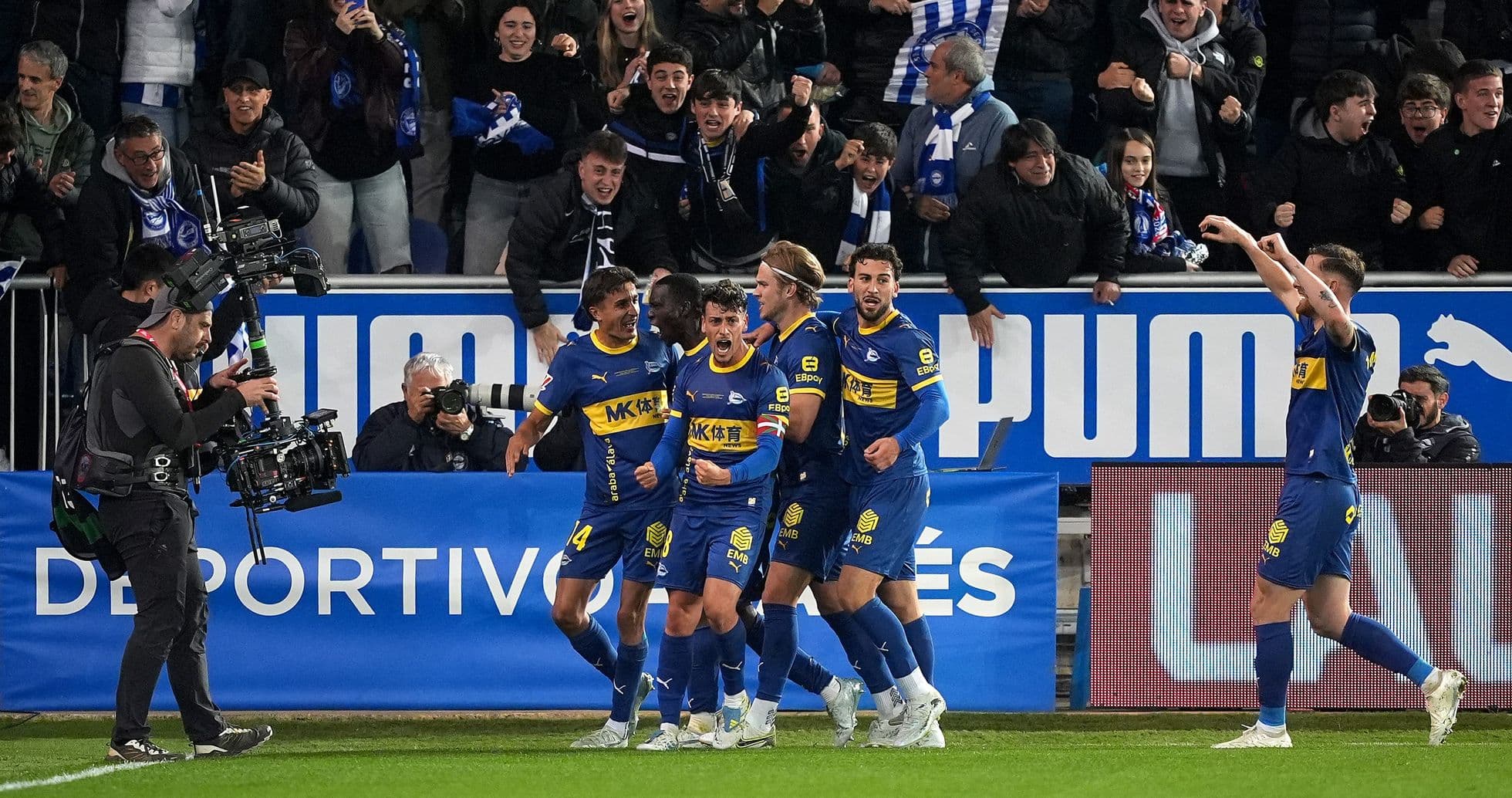
The decisive moment arrived on the stroke of halftime. At 45', I. Diabate (Alaves) scored a Normal Goal, assisted by A. Blanco. It encapsulated Alaves’ game plan: soak up pressure, then break quickly through the forwards once the first line of Barcelona’s press was beaten. That strike produced a halftime score of Alaves 1-0 Barcelona, which remained unchanged through a second half dominated territorially by the visitors but controlled defensively by the hosts.
Discipline unfolded as follows (all Yellow Cards):
- 46' Marcus Rashford (Barcelona) — Foul
- 81' Abderrahman Rebbach (Alaves) — Persistent fouling
- 89' João Cancelo (Barcelona) — Foul
Totals: Alaves 1 yellow, Barcelona 2 yellows, overall 3 cards.
Substitution chronology affected the tactical shapes but not the scoreline. At 62', R. Bardghji (IN) came on for F. Torres (OUT), M. Casado (IN) came on for Pedri (OUT), and P. Cubarsi (IN) came on for X. Espart (OUT), a triple Barcelona change aimed at refreshing the right side and double pivot. Alaves responded at 64' with A. Manas (IN) coming on for I. Diabate (OUT) and P. Ibanez (IN) for D. Suarez (OUT), adding legs in midfield and up front. At 79', J. Cancelo (IN) came on for A. Balde (OUT), pushing Barcelona to a more aggressive full-back profile, before Alaves introduced C. Protesoni (IN) for V. Parada (OUT) at 80' to reinforce the wing-back line. Finally, at 87', T. Marques (IN) came on for M. Bernal (OUT), another offensive tweak that could not unlock the home block.
II. Tactical Breakdown & Personnel
Alaves’ 5-3-2 was built on compactness rather than deep goalkeeper heroics. With “Goalkeeper Saves” listed as 0, A. Sivera’s contribution was primarily positional and organisational: holding a high starting position behind a tight back five of A. Rebbach, V. Parada, V. Koski, N. Tenaglia and A. Perez, squeezing space between the lines and denying Barcelona depth runs for R. Lewandowski and M. Rashford. The defensive unit’s success is reflected in Barcelona’s shot profile: 8 total shots, 0 on goal, and only 4 inside the box, many under pressure or from poor angles.
The Alaves midfield trio of D. Suarez, A. Blanco and J. Guridi worked vertically compact with the back line, accepting a mere 23% of Ball Possession and just 190 total passes, of which 112 were accurate (59%). Rather than contesting the ball, they prioritised blocking central passing lanes into D. Olmo and R. Lewandowski’s feet. The wing-backs, especially A. Rebbach on the left, were aggressive in stepping out, which eventually produced his 81' booking for Persistent fouling but also consistently disrupted Barcelona’s rhythm in wide overloads.
In attack, T. Martinez and I. Diabate served primarily as outlets. The goal sequence at 45' showcased Alaves’ vertical trigger: upon recovering the ball, A. Blanco found Diabate quickly, exploiting the brief disorganisation in Barcelona’s rest defence. With Barcelona’s full-backs high and the double pivot stretched, Diabate attacked the space with directness, turning one of only 9 Total Shots into the game’s only goal.
Barcelona’s 4-2-3-1, under Hansi Flick, produced dominant possession (77%) and impressive circulation numbers: 676 Total passes, 605 accurate (89%). M. Casado and M. Bernal as the double pivot provided a stable platform, and the back four of A. Balde, A. Cortes, P. Cubarsi and J. Kounde pushed high, pinning Alaves back. Yet the lack of incision in the final third was stark. With 0 Shots on Goal and an xG of 0.59, much of Barcelona’s play was sterile, circulating in front of the block without consistently breaking the last line.
R. Lewandowski was often isolated between three Alaves centre-backs, while the nominal attacking midfield trio of M. Rashford, D. Olmo and R. Bardghji (before his substitution) struggled to find pockets between Alaves’ midfield and defence. Rashford’s 46' Yellow Card for Foul, immediately after the restart, reflected growing frustration as he dropped deeper to influence build-up, sometimes arriving late in duels. The late introduction of J. Cancelo for A. Balde at 79' added a more creative profile on the flank, but Cancelo’s 89' Yellow Card for Foul underlined how often Barcelona’s counter-press became their main defensive tool against Alaves’ rare transitions.
In goal, W. Szczesny faced 3 Shots on Goal and made 3 Goalkeeper Saves, with a goals prevented value of 0.12, indicating he did his part to keep Barcelona in the contest after the first-half concession. However, with his side unable to test Sivera at the other end, his shot-stopping could not alter the outcome.
III. The Statistical Verdict
The numbers underline a paradox: Barcelona’s overall form within this match, measured by possession and passing dominance, was strong, yet their attacking efficiency was poor. Their 0.59 xG from 8 Total Shots and 0 Shots on Goal demonstrates how rarely they converted territory into genuine danger. Alaves, by contrast, generated 0.66 xG from 9 Total Shots, 3 on goal, and 7 inside the box, reflecting more selective and higher-quality opportunities despite far fewer attacks.
Alaves’ Defensive Index in this fixture was excellent: 14 Fouls and just 1 Yellow Card suggest controlled aggression, while the back five limited Barcelona to speculative efforts. Barcelona committed only 8 Fouls but picked up 2 Yellow Cards, a sign that their few defensive actions were often reactive rather than proactive. Corner Kicks (6 for Alaves, 4 for Barcelona) show that even set-piece volume tilted slightly toward the hosts, belying the possession split.
Passing data further emphasises the contrast in styles. Alaves’ 190 passes, 112 accurate (59%), were functional and vertical; Barcelona’s 676 passes, 605 accurate (89%), created structure but not penetration. With both goalkeepers posting identical goals prevented (0.12), the difference came not from shot-stopping heroics but from structural clarity: Alaves executed a low-risk, transition-focused plan perfectly, while Barcelona’s ball-dominant model lacked the final-third mechanisms to break a disciplined 5-3-2 at Estadio Mendizorrotza.