.svg&w=384&q=75 "Pitchgist logo")
World Cup 2026: Messi, Mbappe, and the Underdogs Shine
The World Cup has finally caught fire. Lionel Messi, Kylian Mbappe, Erling Haaland and now Cristiano Ronaldo have all left fingerprints on 2026 already, and the tournament many feared would be bloated at 48 teams has instead felt breathless, chaotic, alive. Cape Verde, Japan, Egypt and a clutch of so‑called minnows have torn up the script and proved this expanded World Cup can still be ruthless at the sharp end.
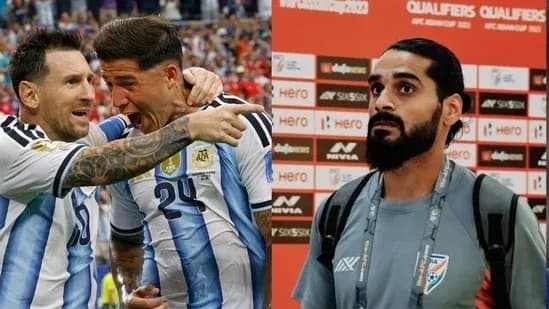
Watching it all, and dissecting it from the studio, is India defender Sandesh Jhingan, part of the Zee5 expert panel. Speaking to Hindustan Times Digital, he cuts through the noise around Messi, Mbappe, Ronaldo and the rest with the perspective of someone who knows what it costs to survive at elite level.
Messi at 39: “He makes you feel like a kid”
Messi, at 39, is supposed to be a nostalgia act. Instead he has opened his title defence with five goals in two games, sprinkling hat-tricks and braces across another World Cup as if time has no claim on him.
For Jhingan, the numbers only tell half the story.
“The hardest thing,” he says, “the greatest talent you can have, is that consistency, performing at such a high level and having the longevity with it.”
He speaks less like a pundit and more like a fellow pro marvelling at an impossible standard.
He recalls a moment from the studio. A 100-year-old woman in the stands, caught on camera while Messi weaved his magic. Jhingan knows the feeling. “When you watch Messi, it gives you that feeling of being a kid,” he explains. “That 100-year-old lady must have felt like a 10-year-old watching him play. He gives you that kind of joy.”
It’s not just romance. It’s structure.
Argentina’s iron shell that frees the king
Argentina have not conceded a goal yet. They are not simply riding Messi’s genius; they are protecting it.
“The reason Messi is doing so well is because the team’s shape and compactness are so good,” Jhingan points out.
He reserves special praise for Lionel Scaloni and his staff. The hallmark of the best coaches, he insists, is not imposing a rigid philosophy but moulding a system around their stars.
Argentina shift their block with cold clarity. Sometimes they sit deep, sometimes they squeeze in a mid-block, but they rarely look stretched. The defenders and midfielders understand their task: win it, give it to Messi, let him decide.
“That structure gives Messi the freedom to operate higher up the pitch,” Jhingan says.
The belief that he will create something once the ball finds him doesn’t just shape tactics; it fuels the entire squad’s confidence.
Lautaro’s graft and the “Messi dependency” myth
Lautaro Martinez’s display against Austria was a study in selfless work. He dropped back, pressed, chased channels, helped defensively and still found the legs to run in behind. The criticism? The strikers haven’t scored enough, and Argentina lean too heavily on Messi.
Jhingan shrugs at the complaint.
“If I’m an Argentine player or a fan, I wouldn’t mind being called reliant on Messi as long as the team is winning,” he says.
For him, the narrative of dependence misses the real story: a robust system that amplifies its star rather than hides behind him.
Their organisation, their discipline, the way they stay compact and know exactly when to retreat or hunt in packs – that, he argues, is as vital as any moment of Messi magic. “At the end of the day, they are winning consistently and have already reached the next stage,” he notes, pointing again to the coaching staff for building a side where every player knows his role.
Mbappe and the weight of a legacy chase
On the other side of the draw, Mbappe continues to stalk World Cup records. Goals, numbers, decisive moments – his tournament résumé at 27 or 28 already looks absurd.
“What he has achieved is mind-blowing,” Jhingan says, but he refuses to rush him into the pantheon.
The bar, he reminds, is now set by Messi and Ronaldo. Two decades of relentless output. Two careers that turned consistency into an art form.
“How do you put him in that bracket?” Jhingan asks. The answer, for him, lies in time. Can Mbappe stay as motivated, as fit, as ruthless? The signs are promising. “Whenever the World Cup is there, that guy just brings an extra level,” he says, recalling 2018 and 2022. That ability to rise when the stage is biggest is, to Jhingan, the signature of a true giant.
Lamine Yamal and the defender’s dilemma
Lamine Yamal has not yet become a 90-minute fixture, but he has already bent games with his cameos. For defenders, he is a nightmare in its purest form: a winger whose first instinct is always to attack his man.
“If you’re in a one-on-one situation with Lamine, most of the time he’s going to get past you,” Jhingan admits. He calls him one of those players “you pay to watch” because of the sheer joy he injects into the game.
But he is quick to stress that trying to win every individual duel is the wrong way to think. A defender can be flawless for 90 minutes, he says, and still be painted as the loser if one shot, one deflection, one moment goes against him.
His solution is collective, not heroic. Keep the team compact. Limit the zones where Yamal receives the ball. Cut the supply at source. That means midfielders pressing, forwards pressing, the back line holding high. “Of course, he will get opportunities,” Jhingan concedes. The aim is not perfection; it is reduction.
Ronaldo, the critics and a “bold statement”
No conversation about this World Cup escapes the Ronaldo debate. At 41, every miscontrol, every missed chance becomes fuel for the argument that he should be benched.
Jhingan does not hide behind polite neutrality.
“I’m going to give a bold statement,” he says. “All this debate is from the ones who never played professional football, or who never played much of it professionally.”
Opinions are fine, he adds, but only one view really matters: that of Roberto Martinez. “He’s the head coach. If he thinks he’s good enough, he will play.”
Ronaldo, like Messi, lives under a harsher light. If his great rival scores and he doesn’t, the narrative swings to age, decline, the end. Jhingan finds it selective. At club level, Ronaldo finished as top scorer in the Saudi league. He hit heavily in qualifiers as well. “People tend to forget that and just pinpoint,” he says.
He expects a response. “I think today Ronaldo will kind of open his account as well in a big way,” Jhingan predicts, noting how often the Portuguese forward has used doubt as fuel to “shut those critics up.”
Golden Boot race: giants only
Ask Jhingan for a Golden Boot favourite and he keeps the shortlist brutally simple.
“I think it could be between Messi and Mbappe,” he says, even if he reminds that it’s still early, only two games in.
Messi’s five-goal head start gives him a “very healthy lead,” but Haaland lurks, and the Norwegian’s presence completes the trio the world expected to dominate this tournament.
“It’s all three of the biggest names which people wanted to score,” Jhingan says. He folds Ronaldo into the picture too, convinced the veteran will soon join the party. For the neutral, it is the perfect script: “More goals, more fun, more excitement.”
A defender’s heart and an Asian dream
When the conversation turns to potential champions, Jhingan drops any pretence of neutrality.
“I’m going to be biased,” he laughs. “I’m going to root for Japan.” The Asian flag-bearers have already lit up the competition, and for an Indian international, their rise carries an extra charge. “I want them to go as high as they can,” he says, even as he acknowledges that Argentina and the usual heavyweights remain ominously placed.
The World Cup has only just cleared its throat, but the storylines are already sprawling: Messi chasing one last golden summer, Mbappe hunting history, Haaland finally on the biggest stage, Ronaldo raging against the dying of the light, and an Asian side Jhingan hopes can crash the gates of power.
The giants are awake. The outsiders are fearless. The question now is not whether this 48-team World Cup works, but who dares to seize it.