.svg&w=384&q=75 "Pitchgist logo")
Villarreal vs Sevilla: Tactical Analysis of a 2-3 Defeat
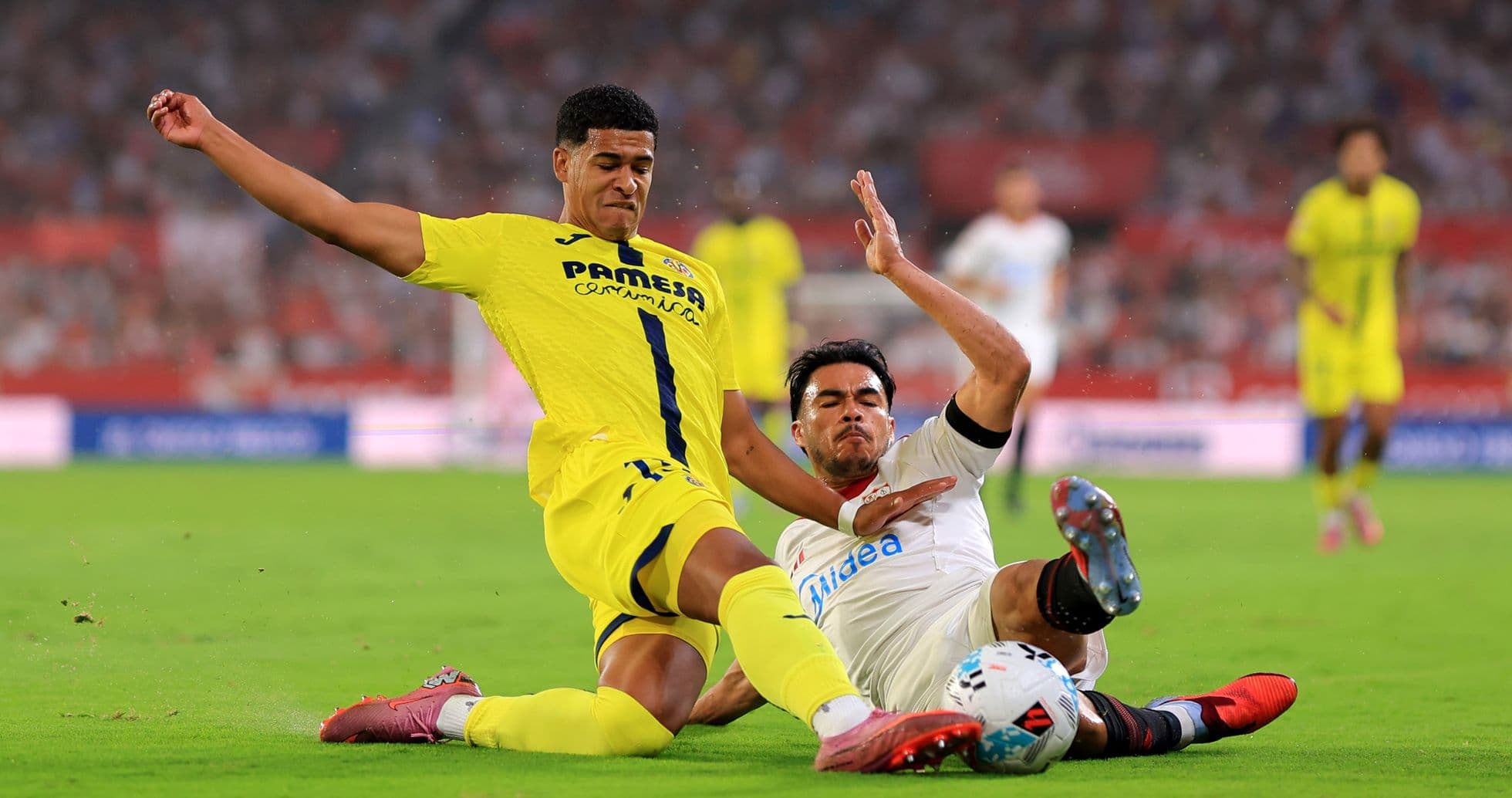
Villarreal’s 2-3 defeat to Sevilla at Estadio de la Ceramica unfolded as a sharp contrast between territorial dominance and structural efficiency. In a La Liga match where the hosts commanded 63% possession and completed 554 passes to Sevilla’s 325, the visitors’ 5-3-2 block and direct attacking patterns proved more decisive than Villarreal’s ball circulation. The halftime score of 2-2 reflected an open, transitional first period; after the break, Sevilla’s compactness and better use of space tilted the game, culminating in a 72nd-minute winner that exposed the fragility of Villarreal’s 4-4-2 once the initial pressing intensity dropped.
The scoring sequence underlined how each side’s tactical plan shaped the game. On 13', Gerard Moreno (Villarreal) finished a move that typified Marcelino’s idea: G. Mikautadze dropped and combined, then released Moreno, whose timing between Sevilla’s wide centre-back and wing-back punished the back five. At 20', roles reversed: G. Mikautadze (Villarreal) struck after A. Moleiro found the inside-left pocket, exploiting the gap behind Sevilla’s midfield line. Villarreal’s 4-4-2 box movements between the lines repeatedly pulled Sevilla’s central trio out of shape in this phase.
Sevilla responded by pushing their wing-backs higher and encouraging L. Agoume to step forward in possession. On 36', Oso (Sevilla), nominally the left-sided defender in the back five, appeared in a high position to finish after L. Agoume broke Villarreal’s first line and found him free on the flank, a clear example of Sevilla overloading wide zones to attack Villarreal’s full-backs. Then, at 45', K. Salas (Sevilla) converted after R. Vargas delivered from the right, capitalising on Villarreal’s difficulty defending crosses with their two centre-backs isolated against multiple targets. That made it 2-2 at the break.
The second half swung on adjustments and energy management. Villarreal, still in 4-4-2, tried to regain control through midfield. At 60', T. Partey (IN) came on for P. Gueye (OUT), and T. Buchanan (IN) came on for N. Pepe (OUT), signalling a shift toward more vertical progression and wing threat: Partey to stabilise build-up, Buchanan to stretch Sevilla’s back five on the right. Yet the structural issue remained: with full-backs A. Pedraza and A. Freeman advancing, Villarreal’s rest defence was often a two-versus-two or two-versus-three against Sevilla’s front and advancing midfield runners.
Luis Garcia Plaza’s response was equally targeted. At 68', J. Sanchez (IN) came on for R. Vargas (OUT), refreshing the right side of the midfield line to maintain Sevilla’s pressing and transition capacity. Villarreal doubled down on control at 70', with S. Comesana (IN) replacing D. Parejo (OUT) and A. Perez (IN) replacing G. Mikautadze (OUT), moves that traded some penalty-box presence and combination play for fresh legs and more off-ball aggression. However, removing Mikautadze reduced Villarreal’s ability to link midfield and attack between the lines, making their possession more sterile.
Sevilla’s decisive moment came at 72'. A. Sanchez (IN) had just replaced N. Maupay (OUT), giving Sevilla a more dynamic runner up front. Immediately, A. Adams (Sevilla) scored after D. Sow threaded a pass that exploited the space behind Villarreal’s advanced full-backs. The 5-3-2 became a springboard: Sow and Agoume could break pressure and release forwards into channels left open by Villarreal’s high line. From that point, Sevilla were content to defend deep, compressing central spaces and forcing Villarreal into wide circulation without clear central penetration.
Subsequent changes from Sevilla at 86'—N. Gudelj (IN) for D. Sow (OUT) and Castrin (IN) for A. Adams (OUT)—were pure game management, reinforcing the defensive structure and adding height and duelling ability to protect the box. Sevilla’s 5-3-2 out of possession often resembled a 5-4-1 in the final minutes, with the second striker and a midfielder dropping to deny Villarreal’s half-space entries.
Discipline reflected the game state and roles. Villarreal collected two yellow cards, Sevilla one, all in the second half as tension rose. The disciplinary log, in strict chronological order, was:
- 81' Ayoze Pérez (Villarreal) — Foul
- 90+2' Renato Veiga (Villarreal) — Foul
- 90+3' José Ángel Carmona (Sevilla) — Time wasting
Ayoze Pérez’s caution came as Villarreal pushed aggressively to recover the ball high, while Renato Veiga’s late booking underlined the desperation in defensive duels as Villarreal chased an equaliser. Carmona’s card for Time wasting encapsulated Sevilla’s late-game strategy: slow the rhythm, break Villarreal’s momentum, and protect their narrow advantage through controlled delays and compact defending.
Statistically, the match framed a clear tactical paradox. Villarreal’s 63% possession, 554 passes, and 499 accurate passes (90%) suggest territorial control, but their 6 total shots, only 4 on goal, and xG of 0.81 reveal that Sevilla’s block successfully limited high-quality chances. Sevilla, with just 37% possession and 325 passes, 276 accurate (85%), generated 13 shots, 5 on target, and a slightly higher xG of 0.88. The visitors turned fewer touches into more and better opportunities by attacking quickly into space rather than trying to construct long positional sequences.
Goalkeeper metrics reinforce the story of defensive fragility on both sides. A. Tenas made 2 saves for Villarreal, with goals prevented at -0.22, indicating he conceded slightly more than an average keeper might from the chances faced. O. Vlachodimos, despite facing fewer shots on target (4), also posted goals prevented of -0.22, suggesting Sevilla’s defensive line did more of the heavy lifting by restricting shot quality, while his individual contribution was marginally below expected.
In the end, Villarreal’s 4-4-2 offered early incision but lacked balance once full-backs advanced and key connectors were substituted. Sevilla’s 5-3-2, initially stretched by Villarreal’s interchanges, gradually asserted itself through disciplined spacing, intelligent wing-back usage, and ruthlessly efficient transitions. The 2-3 scoreline, with all five goals from open play, was a direct reflection of Sevilla’s superior exploitation of space rather than volume of possession.