.svg&w=384&q=75 "Pitchgist logo")
Real Madrid 2-0 Oviedo: Tactical Analysis of La Liga Match
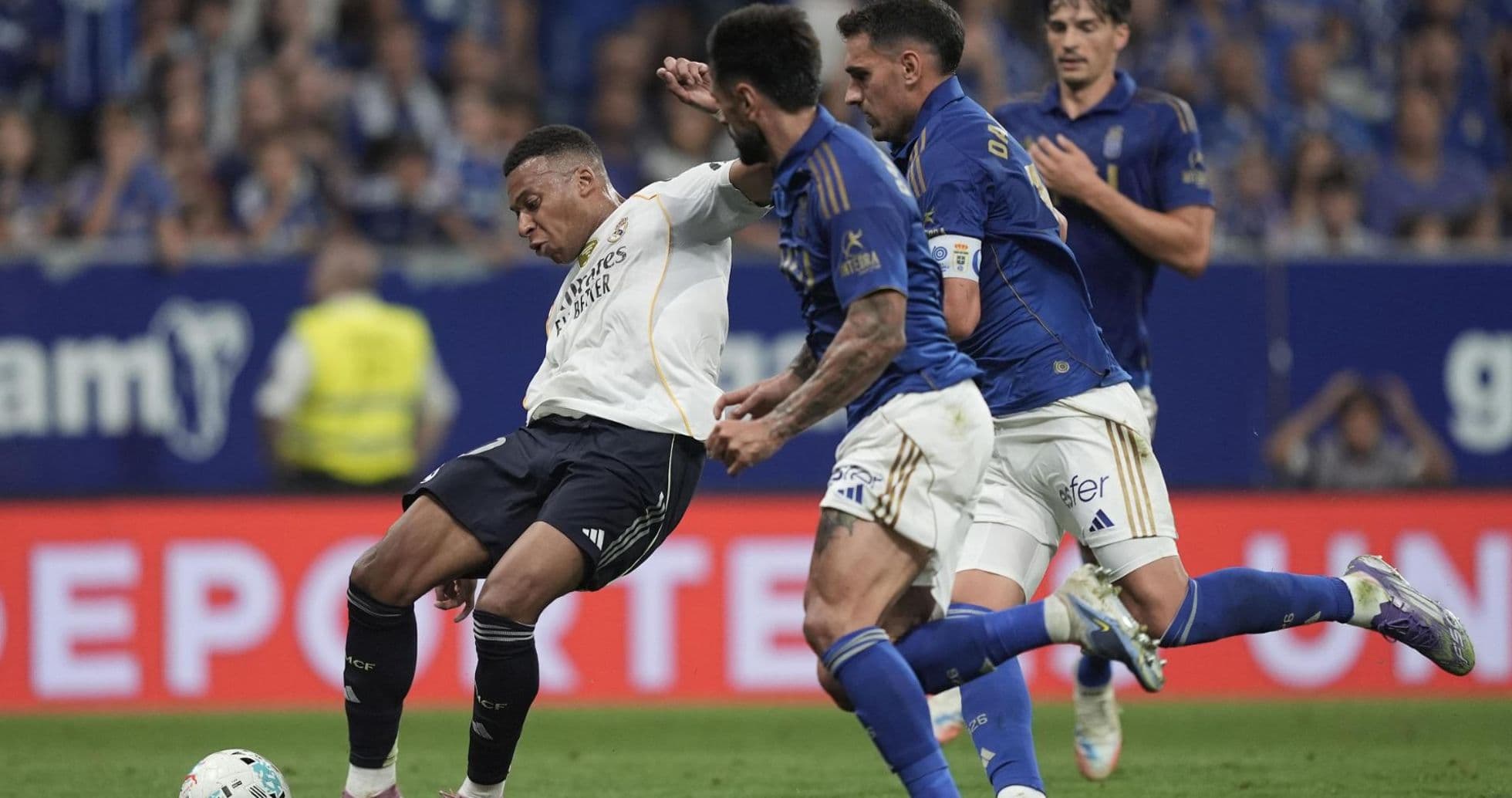
Real Madrid’s 2-0 win over Oviedo at Estadio Santiago Bernabéu was a controlled, methodical performance built on territorial dominance, structured possession, and a clear exploitation of quality gaps in the final third. With 65% of the ball and a 19–9 shot advantage, Alvaro Arbeloa’s side imposed their rhythm, using a 4-4-2 that functioned more like a 2-4-4 in settled attack, while Oviedo’s 4-3-3 oscillated between a mid-block and deep defensive shell, rarely converting defensive effort into sustained attacking pressure.
Executive Summary
The match, part of La Liga’s Regular Season - 36, followed a logical arc: Real Madrid gradually squeezed Oviedo back, broke through just before half-time, then used the bench to raise the technical ceiling and close the game out. The 2-0 scoreline aligned closely with the underlying numbers (xG 1.46 vs 1.03), reflecting a home side that created more and better chances while limiting Oviedo to a single shot on target and mostly low-quality looks inside the box.
Scoring Sequence & Disciplinary Log
Goals (chronological check against events and scoreline):
- 44' G. Garcia (Real Madrid) — assisted by B. Diaz
- 80' J. Bellingham (Real Madrid) — assisted by K. Mbappe
These two goals match the final 2-0 score (Real Madrid 2-0 Oviedo), with Real Madrid scoring once in each half and Oviedo failing to register.
There were no yellow or red cards recorded for either side; the statistics list “Yellow Cards” and “Red Cards” as null for both teams, and the events array contains no disciplinary incidents. As a result, the disciplinary dimension of the match was unusually clean, despite Oviedo committing 14 fouls to Real Madrid’s 7.
The flow of events around the goals is instructive tactically. Garcia’s opener at 44' came at the end of a sustained Real Madrid spell, with B. Diaz providing the assist. The timing—just before the interval—rewarded Madrid’s persistent right-sided probing and punished Oviedo’s inability to clear lines after long defensive phases. The second goal at 80' arrived after Arbeloa had already refreshed his side with high-impact substitutions: K. Mbappe came on at 69' for G. Garcia and then delivered the assist for J. Bellingham’s strike eleven minutes later, sealing control and converting superiority into a secure margin.
Substitutions
(chronological, using mandated format):
- 54' S. Cazorla (IN) came on for I. Chaira (OUT) — Oviedo
- 64' D. Carvajal (IN) came on for T. Alexander-Arnold (OUT) — Real Madrid
- 64' J. Bellingham (IN) came on for A. Tchouameni (OUT) — Real Madrid
- 69' K. Mbappe (IN) came on for G. Garcia (OUT) — Real Madrid
- 69' H. Hassan (IN) came on for T. Fernandez (OUT) — Oviedo
- 77' C. Palacios (IN) came on for B. Diaz (OUT) — Real Madrid
- 77' D. Yanez (IN) came on for F. Mastantuono (OUT) — Real Madrid
- 79' L. Ahijado (IN) came on for N. Vidal (OUT) — Oviedo
- 79' P. Agudin (IN) came on for N. Fonseca (OUT) — Oviedo
These changes significantly altered Real Madrid’s attacking structure in the final third and marginally improved Oviedo’s ball progression, without changing the fundamental pattern of control.
Tactical Breakdown & Personnel
Real Madrid’s 4-4-2 had a clear logic. T. Courtois behind a back four of T. Alexander-Arnold, R. Asencio, D. Alaba, and A. Carreras gave Arbeloa a high technical base in the first line. In possession, Alexander-Arnold pushed high and narrow, often forming a three-man central circulation with A. Tchouameni and E. Camavinga, while Carreras provided width on the left. This created a 3-2 rest-defense structure that allowed both wide midfielders, B. Diaz and F. Mastantuono, to attack aggressively between the lines and outside Oviedo’s narrow midfield trio.
The front pairing of G. Garcia and Vinicius Junior gave Madrid a dual threat: Garcia as a penalty-box finisher and reference point, Vinicius as the primary ball-carrier and destabilizer in wide zones. Garcia’s 44' goal, assisted by B. Diaz, typified the plan: circulation to the right, an incisive action from Diaz, and Garcia attacking the central channel between Oviedo’s centre-backs.
Without the ball, Madrid’s 4-4-2 block was compact and relatively conservative, which explains Oviedo’s 9 total shots and 7 attempts from inside the box despite only 1 shot on target. Madrid were willing to allow some low-quality entries but protected the central lane effectively. Courtois’ workload was light (1 save, 0.16 goals prevented), reflecting a defensive structure that largely forced Oviedo into rushed or pressured finishing.
Oviedo’s 4-3-3 under Guillermo Almada Alves Jorge tried to find balance between protecting the central corridor and providing outlets for transition. The midfield of N. Fonseca, S. Colombatto, and A. Reina was industrious, but they spent long stretches shifting laterally without regaining stable possession. The front three—I. Chaira, F. Vinas, and T. Fernandez—were mostly limited to chasing long balls or isolated counters. Their 35% possession and 325 total passes (275 accurate, 85%) underline a side more reactive than proactive.
The introduction of S. Cazorla at 54' was a clear attempt to add composure and line-breaking passing from midfield. Later, H. Hassan’s entry at 69' and the double change of L. Ahijado and P. Agudin at 79' aimed to refresh wide and central lanes. While Oviedo’s xG of 1.03 suggests they did generate some danger, the lack of precision in the final action and Madrid’s compact box defending kept Courtois largely untroubled.
Arbeloa’s substitutions were decisive in adding vertical threat and control. D. Carvajal for Alexander-Arnold at 64' slightly reduced the playmaking from deep but added defensive security against potential Oviedo counters. More importantly, Bellingham for Tchouameni shifted Madrid towards a more aggressive 4-2-3-1/4-2-4 hybrid, with Bellingham attacking the right half-space and linking with the forwards. Mbappe’s introduction for Garcia at 69' transformed the front line into a high-pace, high-skill pairing with Vinicius. The second goal at 80'—Mbappe assisting Bellingham—was the purest expression of this upgraded attacking quality: elite movement, timing, and execution in the space behind a tiring Oviedo back line.
C. Palacios and D. Yanez entering at 77' for B. Diaz and Mastantuono maintained energy and defensive work in wide areas, ensuring Madrid could see out the game without sacrificing the ability to threaten in transition.
The Statistical Verdict
The statistical profile supports the tactical reading. Real Madrid’s 65% possession, 616 total passes with 570 accurate (93%), and 19 total shots (7 on goal, 5 blocked) illustrate sustained territorial dominance and consistent chance creation. An xG of 1.46 against 2 actual goals indicates a slight overperformance but well within normal variance, particularly given the quality of the finishers involved.
Oviedo’s 35% possession and 325 passes (275 accurate, 85%) show a team that could circulate under little pressure but struggled to progress consistently against Madrid’s structure. Their 9 shots, with 7 inside the box yet only 1 on target and xG of 1.03, reflect sporadic but imprecise threat—half-chances rather than repeated clear opportunities.
Defensively, Madrid committed only 7 fouls and faced 5 corner kicks, suggesting controlled aggression and good positioning rather than emergency defending. Oviedo’s 14 fouls, by contrast, point to frequent last-ditch interventions as Madrid’s attackers found pockets between lines. The goalkeeping metrics—1 save and 0.16 goals prevented for Courtois, 5 saves and 0.16 goals prevented for A. Escandell—underline the qualitative gap: Oviedo’s keeper had to work significantly harder just to keep the scoreline respectable.
Overall, Real Madrid’s 2-0 home win was a coherent expression of a possession-dominant side leveraging structure and bench quality to turn statistical superiority into a secure, controlled result.