.svg&w=384&q=75 "Pitchgist logo")
Jose Mourinho Addresses Real Madrid Speculation Amid Benfica's Champions League Chase
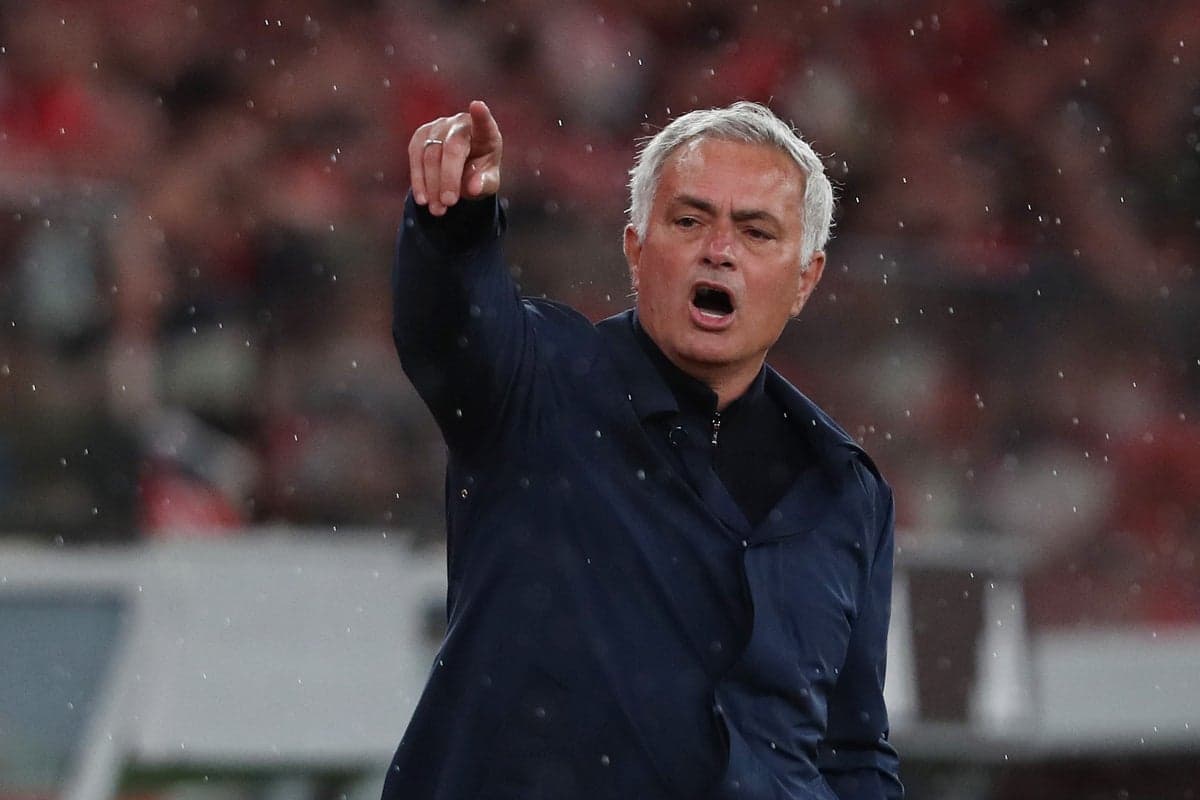
Jose Mourinho has drawn a clear line in the sand: Benfica’s Champions League fate will not dictate his next move, even with Real Madrid circling.
The 63-year-old is once again at the centre of a familiar storm. Reports in Spain and Portugal have placed him among the leading contenders to take over at the Bernabeu, where Alvaro Arbeloa is under mounting pressure after a turbulent season. Madrid are bruised, beaten to the league by Barcelona and out of the Champions League at the quarter-final stage for a second straight year. When that happens in the Spanish capital, the conversation always turns to the bench.
Mourinho, though, is not playing along.
He walked into Benfica in September and has not lost a league game since. One match to go, an unbeaten record still intact, and yet no guarantees. A 1-1 draw with Braga on Monday has left Benfica two points adrift of second-placed Sporting Lisbon, with only Saturday’s decisive meeting with Estoril left to rescue automatic Champions League qualification.
That is the backdrop to the noise around him, and he knows it. At his post-match press conference, the questions quickly moved away from Braga and Estoril and straight towards Madrid. Mourinho cut them off.
“You’re talking about Real Madrid, I’m not talking about Real Madrid,” he said. “I’m talking about Benfica, and the work we’ve been doing won’t change because we’re second or third. That’s not what’s going to influence my future.
“Obviously, Benfica wants to play in the Champions League, and so do I as a coach, but it has no influence whatsoever.”
It was classic Mourinho: direct, controlled, and pointed. The message was not only for the journalists in the room, but for the directors in Madrid and Lisbon who know exactly how much weight his words carry.
The lure of Madrid is obvious. Mourinho’s first spell there, from 2010 to 2013, yielded a La Liga title and a Copa del Rey, and injected an edge into a rivalry with Barcelona that defined an era. He knows the club, the pressure, the politics. He also knows that when Real Madrid come calling, most coaches listen.
Right now, though, the crisis is theirs, not his. Madrid’s season reached its nadir on Sunday night when defeat to Barcelona handed the title to their great rivals. Dressing-room unrest has spilled into public view, and the Champions League – their traditional escape route – has not offered any relief. Last year, they fell to Arsenal in the quarter-finals. This season, Bayern Munich sent them out again at the same stage, 6-4 on aggregate, a scoreline that flattered neither their defending nor their aura.
That sequence has forced the hierarchy to consider a reset. Changing the coach is usually the first step. Mourinho’s name, given his history and his availability in the medium term, was always going to surface.
He is not denying the interest. He is simply refusing to let Benfica’s league position become a bargaining chip in the discussion. Whether his team finish second or third, whether they walk straight into the Champions League or have to fight through qualifiers, he insists his decision will rest on something deeper than a single line in the standings.
For Benfica, that stance cuts both ways. On one hand, it keeps the focus on Saturday’s showdown with Estoril, where an unbeaten league campaign is on the line and the financial and sporting boost of Champions League football hangs in the balance. On the other, it leaves a lingering question: if not Champions League qualification, what will convince Mourinho to stay – or to go?
Madrid, wounded and impatient, are unlikely to wait quietly for an answer.