.svg&w=384&q=75 "Pitchgist logo")
Champions League Final: PSG Edges Arsenal Amidst Record Viewership
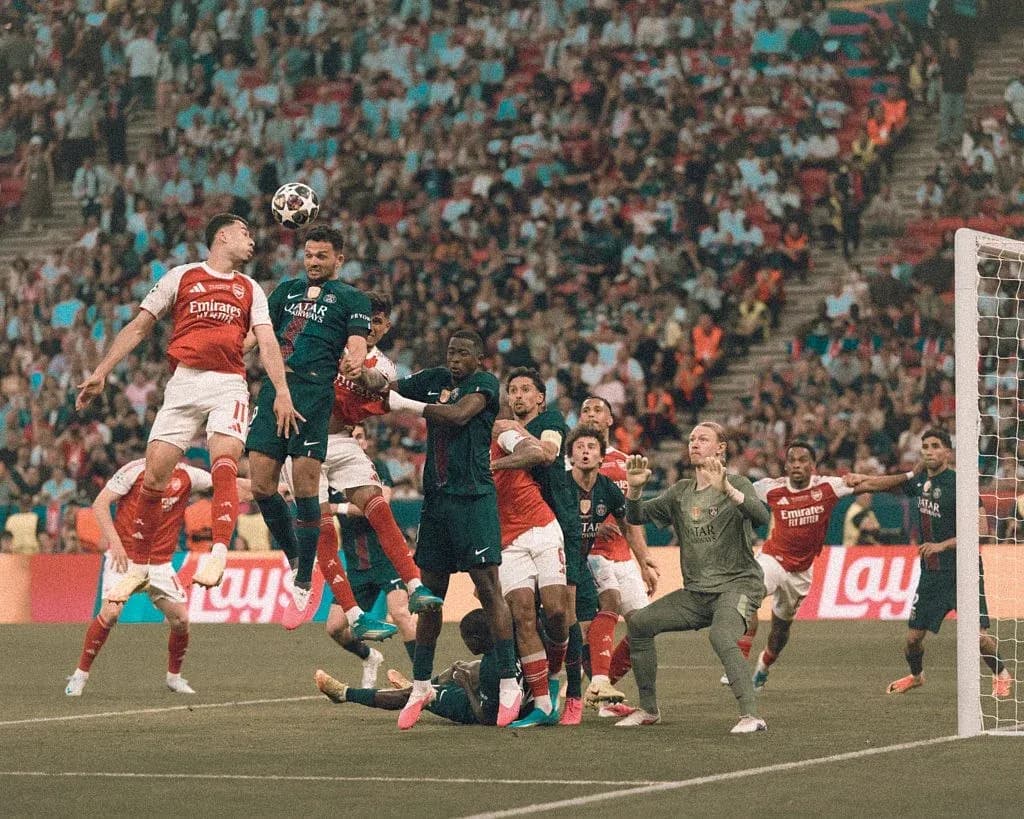
On a humid late-May night in Budapest, PSG clung to their UEFA Champions League crown, edging Arsenal 4-3 on penalties after a tense 1-1 draw at Puskás Aréna. The drama felt total: a European heavyweight, an English challenger, a final that went the distance.
Yet the most startling numbers from the evening didn’t come from the pitch. They came from the screens.
A final watched in secret
Across four key markets – the UK, France, Hungary and the United States – the game pulled in a combined audience of 33.7 million. Respectable for a club final. But the real story sat beneath that headline figure.
In the UK alone, an estimated 16.2 million people watched via illegal streams. Not in pubs, not on official apps, not on any sanctioned broadcast. On feeds found in group chats, on social platforms, on websites that vanish as quickly as they appear.
Those illegal viewers outnumbered the total official audience across all four markets combined, which stood at 12.9 million. One country’s shadow audience beat the sanctioned viewership of four.
The final was not available free-to-air in the UK. Faced with a paywall on a night when Europe’s biggest club prize was on the line, millions simply worked around it.
The UK leads – just not how broadcasters would like
The UK delivered the largest overall audience at 19.4 million. Of that, 16.2 million came from illegal streams. Just 3.0 million watched through TNT Sports and HBO Max, while around 200,000 were estimated to have seen the game out of home.
France followed with 9.5 million viewers across M6 and Canal+, reflecting PSG’s bid to defend their title and the country’s grip on its home champion. In the United States, the match drew 4.8 million viewers on CBS, Univision and Paramount+, riding a wave of heightened interest in football during a World Cup summer.
The stadium itself added another layer. Inside Puskás Aréna, 61,035 spectators watched the final unfold, while YouGov Profiles data suggests just under half a million Arsenal and PSG fans packed bars and pubs across London and Paris. Streets, screens, stadiums – the final was everywhere, even when it technically wasn’t.
Arsenal lose the trophy, Emirates wins the broadcast
On the scoreboard, PSG prevailed. In the numbers that matter to sponsors, Arsenal’s front-of-shirt partner stole the night.
YouGov Sport’s Brand Exposure analysis shows Emirates logged 2 hours and 52 minutes of on-screen exposure, earning a Brand Impact Score (BIS) of 3.54. PSG’s sponsor, Qatar Airways, recorded 1 hour and 54 minutes with a BIS of 3.25. That gap is not cosmetic. It points to Arsenal’s players being on screen more often during crucial phases – attacking moves, last-ditch blocks, close-ups of reactions, and the slow-motion replays that live on in highlights packages.
Emirates outperformed Qatar Airways on the key ingredients that make a logo stick in the mind. Slightly larger branding. Stronger on-screen prominence. More moments where their logo appeared alone, with less competing clutter. Longer average exposure each time it appeared.
Those details pushed Emirates to a higher BIS than Qatar Airways (3.54 vs 3.22), turning visibility into impact. While PSG lifted the trophy, Arsenal’s shirt sponsor quietly extracted more value from the spectacle.
For brands pouring millions into shirt deals, that matters. A gallant, front-foot performance from the losing side can deliver more commercial return than a more clinical victory. This final proved it.
Forty-two billion impressions: a match that refused to end
The final whistle in Budapest didn’t close the book. It opened a new chapter online.
Across just 48 hours – 30 and 31 May – the Champions League final sparked more than 40,500 social media posts, 13,700 videos and 24,500 online articles. The digital echo was vast: 42 billion potential impressions, 1 billion video views and 10 billion in potential readership.
PSG rode that wave better than anyone. The club’s official accounts generated 8.6 billion impressions and 418.6 million video views, far outstripping Arsenal’s 3.7 billion impressions and 49.7 million video views. The difference was not only in result, but in sheer volume of content. PSG pushed more, reached more, and extended their victory far beyond the 120 minutes and penalties.
The trophy stayed in Paris. The conversation largely did too.
When fans become brand advocates
Behind the exposure numbers sits something harder to buy and even harder to fake: how fans actually feel about the brands on their shirts.
Using YouGov BrandIndex, Recommendation levels for Emirates among Arsenal supporters in the UK and Qatar Airways among PSG supporters in France were measured against their general populations. In both cases, club fans were significantly more likely to recommend the sponsor than the wider public. The bond between club and brand ran deeper than a logo.
Emirates saw an uplift in Recommendation among Arsenal fans around the time of the final, a sign that the drama in Budapest – and the journey to get there – nudged sentiment in the right direction. Qatar Airways, by contrast, maintained consistently strong Recommendation levels among PSG supporters across the period measured, reflecting a stable, established partnership.
YouGov Sport’s BIS-X framework folds this kind of fan perception into the hard data of exposure. It recognises that visibility is only half the story; the other half is whether fans actually like and advocate for the brand they see. The stronger rise in Recommendation among Arsenal supporters suggests Emirates gained on both fronts: more time on screen and more vocal backers off it.
For sponsors, that is the sweet spot.
Beyond who watched
This final underlined a simple truth about modern sponsorship: counting eyeballs is no longer enough.
Audience size, Brand Exposure, social buzz, fan sentiment – each metric tells a different part of the story. A match can be watched by tens of millions, but if a logo is buried in clutter, if fans feel indifferent to the sponsor, if the conversation online flows around the brand rather than through it, the value shrinks.
In Budapest, PSG kept their crown. Arsenal’s sponsor arguably squeezed more out of the night. Illegal streams in the UK exposed a glaring fault line in football’s broadcast model. And across billions of impressions, two airlines fought a quieter, more intricate battle for attention and affection.
The question now is not just who will reach the next final – it is which brands will truly be seen, and which will actually be felt, when they get there.