.svg&w=384&q=75 "Pitchgist logo")
Celtic Fans Split Over Robbie Keane Amid Political Controversy
The debate over Celtic’s next manager has taken a sharp and deeply political turn, with dozens of supporters’ clubs publicly opposing the potential appointment of Robbie Keane.
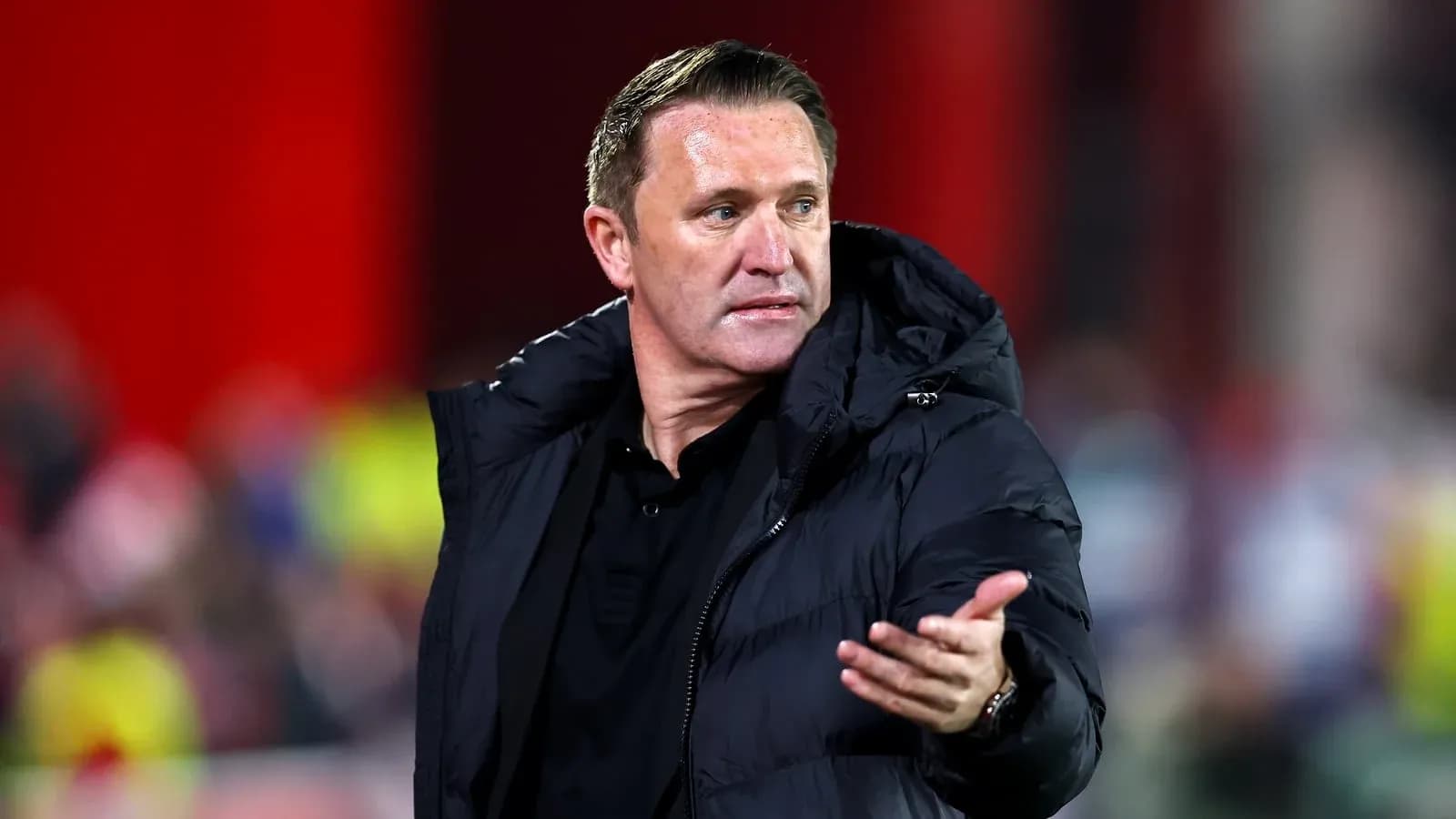
Keane, the Republic of Ireland’s record goalscorer and a former fans’ favourite from a prolific loan spell at Celtic Park in 2010, is among the leading contenders for the job and is understood to be in talks with principal shareholder Dermot Desmond. On footballing grounds alone, his CV carries weight: league titles in Israel and Hungary, a reputation as a sharp, ambitious young coach, and a bond with the club from his playing days.
But this is not a purely footballing argument. Not anymore.
Fans’ groups unite against Keane
Graffiti and banners denouncing the idea of Keane taking charge have appeared outside Celtic Park in recent days. Online, a group calling itself Celtic Fans for the Liberation of Palestine published a statement condemning his spell in charge of Maccabi Tel Aviv.
That message has now been amplified. The North Curve Celtic account on X has released a list of 67 supporters’ groups that it says have endorsed the statement. It is not a fringe coalition. Among the names are the Green Brigade and Bhoys Celtic ultras, prominent podcasts such as the Cynic and eTims, and long-established supporters’ institutions including Glasgow University Celtic Supporters Club (CSC) and Craigneuk Tommy Gemmell CSC.
The statement accuses Keane of crossing a moral line by remaining at Maccabi Tel Aviv after the outbreak of the war in Gaza.
“Celtic supporters have a long and proud history of solidarity with the Palestinian people,” it reads. “For us, Robbie Keane’s decision to manage Maccabi Tel Aviv during the genocide in Gaza is impossible to ignore.
“To choose to manage a club in Israel while, less than 40 miles away, the same country was using indiscriminate weapons of mass murder against defenceless people is unconscionable.
“Celtic was founded by a community shaped by the legacy of genocide, displacement and famine. Our club’s roots lie in solidarity with those who suffered injustice and oppression. We cannot forget where we came from, nor turn our backs on those facing genocide today.
“At a time when Celtic requires unity and collective purpose, this appointment would be deeply divisive among the support. It would also represent a predictable and uninspiring choice at a moment when greater ambition is needed.
“We urge the Celtic board to listen to supporters’ concerns and reconsider this appointment.”
The language is stark, the tone uncompromising. For a significant section of the support, this is not about tactics or transfer budgets, but about identity and conscience.
Keane’s Maccabi spell under the spotlight
Keane took the Maccabi Tel Aviv job in June 2023, months before the Hamas-led attacks of 7 October and the subsequent Israeli bombardment of Gaza. That conflict has since claimed tens of thousands of lives. An independent UN commission reported last October that Israel had committed genocide against Palestinians in Gaza.
In that context, Keane’s decision to stay in his post throughout the season has drawn fierce criticism in Ireland and now in Glasgow.
On the pitch, he delivered. The 45-year-old led Maccabi to a league and cup double before resigning in the summer of 2024. From a purely sporting perspective, it was a triumph.
Off the pitch, the moral questions never went away.
Keane has explained that one of the reasons he stayed was his sense of responsibility to the backroom staff who followed him to Israel.
“I have a duty of care,” he said. “My analyst, for example, was at Middlesbrough for 12 years. For him to come with me to Israel and then for me to just walk away, leaving him and his family….
“So I made the decision to stay until the end of the season and to walk away from a big contract – another year, possibly two more years. We made that decision as a group, as staff.”
For some Celtic supporters, that justification does not come close to offsetting the symbolism of managing in Israel during the war. For others, it will be seen as a professional call in a brutal industry, one that should not define his candidacy for the Celtic job.
A club caught between football and politics
Celtic’s support has long wrapped politics, identity and football into one restless, noisy package. Palestinian flags on European nights, fundraisers, banners and choreographed displays have all underlined where large parts of the fanbase stand on the Middle East.
That history now collides with the board’s managerial search.
The statement’s signatories argue that appointing Keane would cut against the club’s founding ethos, rooted in a community shaped by “genocide, displacement and famine”, and would fracture the unity they believe is needed for the next phase of Celtic’s development. The word they use is “divisive”. It hangs over the whole process.
The board faces a hard choice: push ahead with a candidate whose football pedigree and personal history with the club appeal to some, or step back in the face of organised, values-driven opposition from a powerful section of the support.
The next move will say as much about what Celtic want to be off the pitch as it does about who leads them on it.